
First, the complaints: It's not a starter set. It's a module that just happens to come with five pre-generated characters that give you enough information to take them to 5th level, which the module is supposed to take you to. If they had actually put out the 5th Edition equivalent of the Basic D&D rules (B/X or BECMI, take your pick), I'd have tried it out a long time ago. As is, it just didn't seem worth it, especially since the crippleware D&D 5th Edition "Basic" rules that Wizards put out was lackluster, to say the least.
But pick it up I did, and read it--and it actually looked like a fun romp to play through, if nothing else.
And then Wizards released the SRD, and I started reading through that alongside the "basic" rules. And that intrigued me more--between the free SRD, the free "basic" rules, and the $7 Starter Set, I had everything I needed to start a full campaign for next to nothing.
And then, as I started building out characters (one of the fastest ways to learn a new rules-set in my experience), I started wondering . . . how would a warlock bound to a Great Old One look different than one bound to a fiend? One of my potential players wanted to play that. And I had a gift card still burning a hole in my pocket from my birthday . . .
The next thing I knew I'm placing an order and eagerly awaiting the Player's Handbook . . .

Okay, so, first impressions:
While returning to traditional concepts and play in many respects, 5th Edition is in many other ways as much of a departure from 0th-3rd Edition mechanics as 4th Edition, mostly in the area of monsters and hit dice. Or to put it another way, everything's hit points have been essentially doubled--most monsters have twice as many hit points as their 1st Edition equivalents, and players in turn get "Hit Dice" that they can expend during a "short rest" of an hour or so to heal lost hit points.
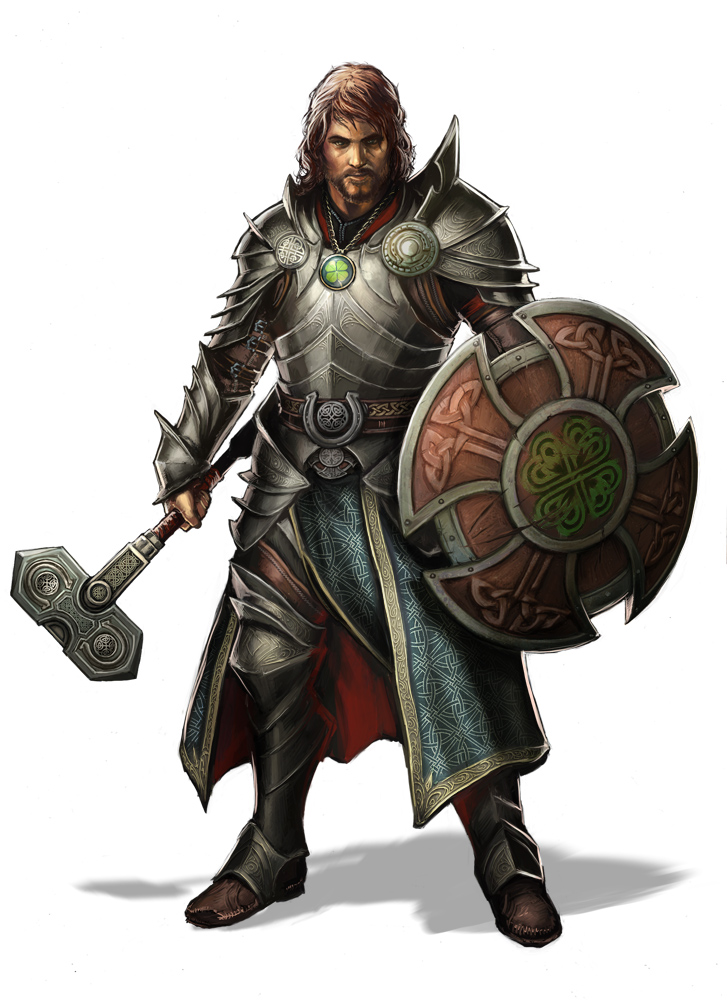 |
| Dammit Jim, I'm a divinely-empowered warrior-priest, not a doctor! |
The mechanics and options look fairly balanced, streamlined, and fun. Character creation is pretty fast--roll attributes, pick race, class, and background, and then just choose proficiencies and jot down the special abilities and equipment that go with your selections. Pick spells if your class needs it. It takes me maybe 10 minutes to make a character now--pretty darn close to what it takes me in zeroeth edition (White Box, B/X, etc.).
Both the fiddliness of 3E and the abject slavery to class selection of 4E have been replaced by the genius of a background mechanic. Your character could have been a soldier, a noble, a hermit, a street urchin, a criminal or a dozen other things before they took up sword, shield, and stave, which gives you additional proficiencies, a few pieces of equipment, and a minor special ability, like a sailor's ability to find passage on a vessel for next-to-nothing or the urchin's ability to find the best way through a city. Heck, half the fun is putting together weird combinations that practically demand a cool background, like an urchin-turned-barbarian, or a charlatan-turned-paladin.
At 3rd level, most classes pick an additional path--a fighter might be a physically-powerful champion, a cagey and skilled battle-master, or learn somewhat of magic as an eldrich knight. It's a fairly cool conceit in that a beginning player won't be paralyzed overly much by too many choices, but will have a chance to choose a more specific path after a few adventures.
Looking at the stats for, say, a bandit or a guard, it's evident that on the one hand, a 1st-level PC is by nature a cut above a normal human (leaving aside demi-humans for a moment)--their ability scores are far higher than that of ordinary people (4d6, drop lowest vs. 3d6), and even your "basic" fighter is already adept at nearly all weapons and has mastered a particular fighting style. So on the one hand, definitely born heroes, but on the other, they're by no means invulnerable super-heroes . . . yet.
So, does that mean that I love everything about 5E, at least as I've read it so far (play-testing will hopefully take place next weekend)? No, not really. There are a few holdovers from 3E and 4E that I'm not particularly happy with:
First, humans don't have anything at all to make them stand out--they just get a +1 to all of their ability scores, or alternatively, get a +1 to two scores, an extra skill, and a feat (which are totally optional in this edition). Given that you've got a dozen non-human races, most of which have 2-3 subraces to choose from, I could see humans becoming a rarity among PCs. Sadly, while the PHB does give a number of different Forgotten Realms cultures for humans to choose from, none of them are really exciting from a player's standpoint because none of the affect mechanics at all. That's something I intend to fix in my own game, but it's somewhat annoying that there aren't even some samples ready to go out of the box.
 |
| On the plus side, my wife loves Doctor Who, and this was what she really had in mind. |
*sigh*
Third, I think that wizards, warlocks, and sorcerors may be a bit overpowered at 1st level by having damage-dealing spells (with damage in the 1d10 range) as cantrips, which can be cast Every. Single. Round. Likewise, several classes can cast light as a cantrip, which leaves us to wonder why anyone ever bothers with torches.
Look, I'm cool with giving wizards more to do, even though a cleverly-played magic-user in 1st edition was still pretty powerful (sleep was an instant win to most fights, and charm person could give you an ogre henchman right out of the gate). But when a wizard can blast most creatures with a mere word and gesture as often as he wants, why on earth would he ever bother carrying a dagger or staff? It's a holdover from 4th edition that I really don't like.
"So just remove damage-dealing cantrips from your game!" Yes, I probably will. But I can't for the life of me see that they enhance the base game.
Fourth, I really think that many of the rules and powers could be written better. There's just too much fluff wrapped around the actual rules. It's not awful, but having each power summed up in a brief sentence would make it easier for a player to figure out what to copy to their character sheet.
However, despite all that, I really do think that I'll enjoy DMing this edition, and my players will enjoy playing it. This will undoubtedly mean shelling out for the DM's Guide and Monster Manual, but from what I can see so far, Wizards deserves the cash.


I enjoyed reading your thoughts. I've been playing 5e for a few months and think it's a fun edition. :-) It has it's flaws - the tank of our party is a mage... and they were the tank at level one - but it keeps everyone engaged (hey, the sorcerer can hang in a fight as opposed to hide) and reasonably fast moving for D&D (provided everyone has a character sheet that they can read and have read what their class' powers are). I've picked up all of the WotC books as well as a number of 3PP products from the bigger companies. I am sold on this edition. :-)
ReplyDeleteEgg Embry