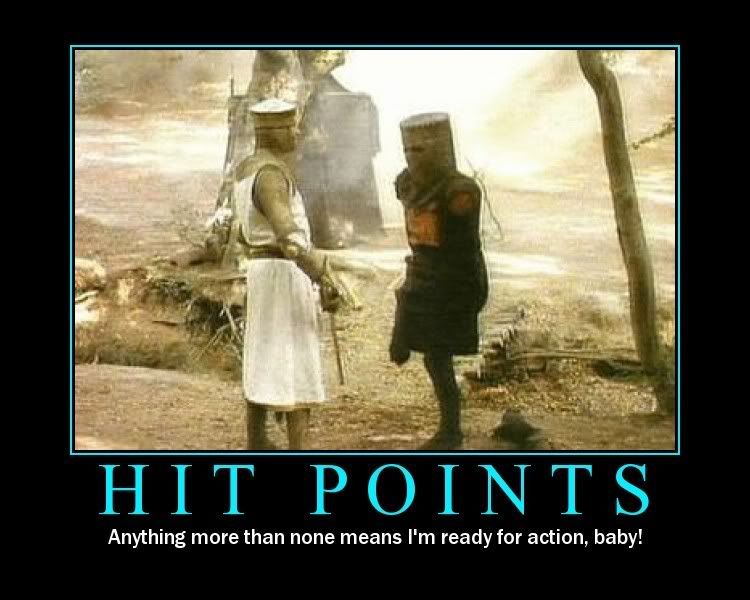
Okay, that needs some context.
This last week, the party decided to cut through the Arrowfell Woods, a place that they already knew to be infested by goblins, to get to their destination. I rolled to see if they encountered anything and yep, sure enough, goblins with a side-order of wolves. That should be a simple enough encounter for a bunch of sixth-level characters, right? Well, hearing the wolves in the distance and not being sure how many were on their tail, they decided to detour to the recently cleared-out ruins of Cragmaw Castle (from Phandelver) so that they could fight from a fortified position. The combat was, and was meant to be, pretty easy. My players were being a little overly cautious, but it sparked a discussion on how easy 5E is compared to the early editions we grew up with.
Easy Recovery
Ultimately, I think the problem comes down to one thing: 5E makes recovery--recovery of hit points, recovery of spells, recovery of special abilities--ridiculously easy. Just rest eight hours and you're good to go. As a result, and as I've mentioned before, it's fun to play in a dungeon crawl environment, but doesn't work so well in a hex-crawl. If you follow the guidelines given on page 84 of the DMG, a party is expected to have an average of six "medium" encounters a day, with time for two short rests. However, that hardly ever happens in a random wilderness encounter, so there's no reason to hold back powerful spells and abilities until later, and no fear of attrition.The PCs can cut loose with all of their most powerful abilities, with little to no fear that they'll need them later.Now to be honest, 3E had a similar problem in that healing spells, abilities, and items were so plentiful that the end of the day typically involved the party cleric converting all of their spells to cure wounds of various levels and bringing the party back to full health. Fourth and fifth edition have just cut out the middle-man in assuming that everyone gets a full recovery when they take a "full," overnight rest. However, in 0E-2E, this really wasn't an option: Clerics and druids could not simply convert everything into healing spells and they only had a limited number of spell "slots" that could be used for healing (1st, 4th, 5th, and 6th for the cleric). The result was that while few parties had to wait around a month to heal at the natural rate of 1 to 3 hit points per day, it generally took several days at least to bring everyone up to full hit points after a major encounter. Slow attrition was therefore as much a problem in the wilderness as it was in the dungeon.
In addition, if played strictly by the rules, magic-users had limited opportunities to replenish their spells on a long journey. They thus had good reason to supplement the spells in their heads with limited-use items like scrolls and wands--and to hold back on slinging fireballs until they were sure that it was really necessary. While 2nd Edition introduced the idea of "travelling spellbooks," and the magic-users in my campaign happily latched on to the idea, they were still expensive to compose and could only hold a handful of the magic-user's spells. Moreover, it took about a turn per spell level to re-memorize spells for both magic-users and clerics, so a high-level character might need the better part of a day to recover a full suite of spells. By 3E, these restrictions--which really did serve to balance the magic-user at higher levels--had been largely lifted. Wizards only needed to carry a single, lightweight spellbook. We also had the introduction of sorcerers, who didn't need to carry a spellbook at all.
"Gritty Realism" Rules
After a discussion with my players, we're tentatively employing the "Gritty Realism" house rules from the DMG (p. 267) in my campaign: A short rest is now defined as lasting 8 hours and a long rest is 7 days, which must be spent resting in one general area without suffering an attack; e.g., a city, an encampment, or anywhere safe and, well, non-mobile. |
| We're not exactly talking about Dark Souls' level of difficulty here |
To gain the benefits of a full rest, a character cannot carouse (if a magic-user), craft, pursue work, a profession or business, engage in crime, pit fight, or train. Carousing (for non-magic-using classes, and as long as serious conflict is avoided), brewing potions of healing, gambling (provided that it doesn’t result in a fight), relaxing, taking part in a religious service, doing research, scribing a spell scroll, and selling a magic item (again, if they can avoid conflict) are all permissible. See the Unearthed Arcana article on downtime for details on these activities. Time spent in a long rest also allows a character to recuperate from injuries, disease, or poison as described on p.87 of the PHB.
This affects not only hit point recovery, but spell and ability recovery as follows:
This affects not only hit point recovery, but spell and ability recovery as follows:
- Characters who take a “breather” can use hit dice to recover hit points at a rate of 1 hit die per hour spent resting. (This is to keep low-level characters in the game.) They can use as many as they wish, up to their maximum, during a short rest (8 hours). A long rest recovers all hit points and hit dice.
- Class abilities that require a short rest to recover now take an 8 hour rest, and those which require a long rest require 7 days, unless otherwise stated.
- Wizards can partially recover their expended spell slots during a short rest (8 hours) by using their Arcane Recovery ability. They fully recover all expended spell slots and can change their prepared spells during a long rest, and then only if they have access to their spell books.
- Bards, Clerics, Druids, and Sorcerers can recover expended spell slots during a short rest exactly like a wizard. Clerics and Druids can only change their prepared spells during a long rest (preferably on holy ground).
- Rangers, Paladins, and Arcane Knights recover a single spell slot per short rest. All spells are of course recovered during a long rest.
- Warlocks regain a single spell slot with an hour’s “breather,” and all spell slots in an 8 hour short rest.
Ramifications
The point of all this isn't really to make the game "harder," at least not in the sense of making character death easier to achieve. It could have that effect on a party pressing hard into a dungeon with a strict timeline (in which case, perhaps the power that sent the party on the quest might speed up their recovery temporarily . . .). But that's a side-issue, not the point. This optional rule instead accomplishes the following:
Slow down the pacing. If you play 5E as is, you can easily have a party climb from 1st to 20th level in the course of just 100 adventuring days (5 adventuring days per level, on average). Even with a reasonable amount of downtime, that only stretches out to a year or two. Now if you're playing something epic on par with Robert Jordan's Wheel of Time, in which the main characters became some of the most powerful entities in their world in the course of just 2-3 years (because they were destined to do so), that's just fine. However, in a standard campaign, or even most fantasy novels, that seems way too short. Setting it up so that the PCs have to have long periods of downtime gives them enough time (700 days of adventure and enforced rest, plus voluntary downtime) so that getting to 20th level actually seems to make sense.
 |
| Just taking a short rest. |
Make hex-crawling a viable challenge. The reduced recovery rates mean that the PCs will need to be more careful with their resources when exploring over the course of several days and find times to retreat to safe territory to recover fully. "Gritty Realism" really amounts to applying dungeon crawl scaling to longer / larger scale adventures. It also keeps resource management in the game longer: A 5th level cleric can create food or water twice, but then can't do it again until the party finds a safe place to rest for a week. Time to send the barbarian and the ranger hunting . . .
But what about dungeon crawls? Well, that depends on the circumstances. If we're doing classic original edition crawls where the PCs are looking for fame and fortune, slowing down the pace simply means that they'll be coming up for air more often and resting for a few days between adventures. This seems to me to be more realistic--and frankly, more interesting--especially in the early levels. A 1st level PC may be a cut above the rest, but he still needs more than a nap to recover from the slash of an orc's greataxe that brought him to 0 hit points.
Make adventuring a challenge without the risk of a random TPK. Fifth edition really speeds up combat at higher levels, but does so by vastly increasing the damage output of high-level characters-- and high-level monsters. This means that if you start throwing a lot of "hard" challenges at the PCs to compensate for their quick recovery, not only will they level far too fast, but the odds of a bad series of dice rolls wiping the whole party out increases almost exponentially. Slowing down the recovery of hit points and magic means that you can use even a series of "easy" encounters to wear down the party's resources over several days. Wandering into a goblin tribe's territory suddenly becomes dangerous again--not in any single encounter, which the party can win handily, but in a longer grind over several days of exploring the dark forest, which will have the players carefully calculating exactly how far they can push before turning back.
Keep magic rare. I don't think that D&D has ever done "low magic" particularly well, but "rare magic"--that is, magic can be incredibly powerful but those mortals who can manipulate it are rare--fits perfectly. However, when your average NPC "Mage" can cast an infinite number of cantrips and fourteen higher level spells a day, take a nap, and do it all over again, one wonders why the streets of major cities aren't lined with continual flame lanterns. (As indeed they are in some campaign worlds.) Slowing down a spellcaster's ability to recover those spells explains why they aren't always eager to cast them for fun and profit.
For example, if we go by the 2nd Edition World Builder's Guidebook, an average town is only about 75% likely to have a wizard at all, and if there is one, he will be of 2nd-7th level. If we assume the average of 5th level, he can only replace 3 spell levels worth of slots a day, so he might not wish to cast that 3rd level spell just for money. After all, what if the PCs are enemies trying to trick him into weakening himself so that they can steal his secrets? If he casts all his spells (a total of 14 levels worth) it will take him five days to recover, during which he might be vulnerable to other wizards trying to steal his secrets.
Provide a rationale for limited-use items. As I noted back here, limited-use magic items make perfect sense in early editions if the DM is smart enough to strictly enforce and exploit the weaknesses of spellbooks. However, they make little to no sense in the context of 5E (or 3-4E). Why bother spending four days and 100 gp to create a 1st level spell scroll or 20 days and 500 gp to create a 3rd level spell scroll--let alone 200 days and 5000 gp to create a wand of lightning bolts--when you just get all of your spells back after eight hours of piddling around? These items only make sense if there's a real cost to using up a spell slot, and you don't know if you'll be able to get it back before the next battle.
Fifth edition greatly lowered the number of scrolls and wands floating about, but given how easy scrolls are to destroy, they still only make sense if a large number of wizards make them as a matter of course.
Avoid the murderhobo syndrome. Player characters, or so the cliche goes, are a bunch of murderous hobos who wander around killing everything in sight for experience and gold. And, if they never need more than a night to recover, why shouldn't they be? But if--especially in the case of the spellcasters--they need safe places to rest up from time-to-time, they're more likely to want to make friends. If the PCs decide to just tick off and kill everyone, they're going to find themselves hounded with no chance to rest and recover their most potent abilities and spells, and will eventually be worn down and slaughtered by the forces of Law. As it should be . . .
Caveats
Obviously the PCs have to adjust their play-style to accommodate "Gritty Realism." But what about the DM?
Calibrate expectations. We live in a time of instantaneous communication, near-instantaneous travel, and the accelerated pace of life that goes with them. Ancient and medieval peoples weren't like that. A king could afford to spend five years touring his kingdom, setting up temporary courts in all of its cities, because he wasn't limited to a four-year term. Armies could only move about 5-10 miles a day, so a small group could easily outpace one. Everyone had to take weeks or months to recover from wounds taken in battle, and tactics were developed around this fact. In the same way, fantasy campaign life should move at the speed of horse, not the speed of light. The DM needs to find ways to cue his players in on this fact.
Adventures must have a slower pace. Think of adventuring days like adventuring hours spent in the dungeon. If the players do enter a dungeon, make sure that you design it so that they won't be instantly hemmed in, worn down, and destroyed by the denizens. The players need to have the opportunity to withdraw and recover when they have to. Which brings us to . . .
Adventure pace should mostly be driven by the players, not the DM. In fact, adventures should more often than not be driven by the pacing of the characters, not external events. PCs planning on killing a dragon in a distant cave and looting its hoard will have every reason to spend months in preparation, readying supplies, crafting items, hiring henchmen, and readying spells. And the payoff, if they play well, should be well worth it. On the other hand, if your campaign is a race to save the world in a very limited amount of time, "Gritty Realism" may not work for you.
This means that you need to carefully consider living expenses when dolling out treasure. In just a week of recovery, PCs will spend at least 7 gp just to maintain a modest lifestyle--and let's be blunt, it's far more interesting and heroic if they can safely blow the 28 gp needed to maintain a wealthy lifestyle, or additional gold to pursue other interests. They may also have hirelings to support, hirelings who are critical to the success of the next venture. If the PCs occasionally burn themselves down to their last copper, that fits perfectly in the swords-and-sorcery genre. But they shouldn't always be poor and wondering if they have enough coin to rest up before their next adventure.
This isn't to say that established NPCs shouldn't have their own agendas, some of which might pit the PCs against the clock. However, such occasions shouldn't dominate the campaign (that way lies railroading)--they should be relatively rare, usually as a result of the PCs actions in one way or another, and calibrated to handle the longer recovery times. In a sense, they're no different than 5E's standard time-based missions--just spread out over weeks instead of hours or days.
Use lots of easy encounters, not a few hard ones. One of the advantages of this alternate rule is that even a tribe of goblins can successfully harry and wear down a party over several days, so you can use lots of "common" creatures and save really powerful ones for epic, rare encounters. However, this means that the standard "six encounters a day" can very easily wipe out a party very quickly. You not only need to adjust your personal adventure design, but if you're using modules you may need to rewrite them to a great extent . . . or else decree that the gods have blessed the PCs with a "normal" recovery rate for a short period of time.
Reward non-combat victories. This should go without saying, but . . . In D&D's earliest incarnations, experience was primarily rewarded on the basis of how much treasure you managed to bag. This meant that the PCs had every motivation to try to steal, negotiate, or trick their way to treasure without a fight. However, since 3E the focus has been on rewards for overcoming "challenges," primarily fights with monsters.
PCs with more limited resources and longer recovery times will naturally be driven to sneak, bluff, trick, and magic their way to victory with as few actual fights as possible. Never rob them of their reward. Your campaign will more resemble Firefly than Conan, but in the end, that's not such a bad thing.
Conclusion
Dungeons & Dragons' 5th Edition "Gritty Realism" rule is not, in the grand scheme of things, about making the campaign "harder" or "more deadly"--at least not if you're a good DM. It's about slowing things down and bringing them to a human level, giving a rationale to many of the magical items that litter the standard D&D world, and making wilderness adventures as viable as location-based adventures.
The standard recovery rules make sense as an outgrowth of 4th Edition. They also make sense in today's gaming world, where challenge takes a back seat to "narrative." All the same, I can't help but feel that 5E sacrificed an important element of gameplay by making recovery so easy, and wonder how its many commercial modules would have evolved differently if the "gritty" rules were the norm rather than the exception.


No comments:
Post a Comment